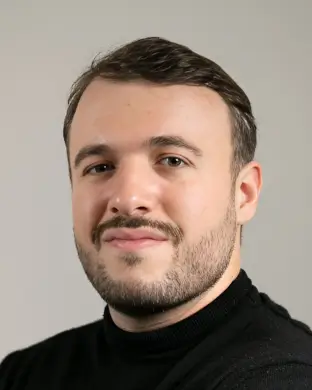
Alexandre Bordat

Embedded Systems Engineer and CIFRE PhD Student in Computer Science

Ingénieur en systèmes embarqués et Doctorant CIFRE en informatique

Bio

Age
28
Email
Téléphone
+33 6 70 82 37 17
Adresse
6 Av. du Ponceau, Cergy, France

À propos de moi

Hello! My name is Alexandre Bordat, a fervent enthusiast of data processing, whether it's signals, images, or others, and I am particularly interested in their effective application on various architectures such as CPUs, GPUs, and FPGAs. As an embedded systems engineer and CIFRE PhD student in computer science specializing in data processing, I have an insatiable thirst for learning and an ability to quickly assimilate new knowledge.

Bonjour ! Je me nomme Alexandre Bordat, un fervent passionné de traitement de données, qu'il s'agisse de signaux, d'images, ou autres, et je m'intéresse particulièrement à leur application efficace sur diverses architectures telles que les CPU, GPU et FPGA. En tant qu'ingénieur en systèmes embarqués et doctorant CIFRE en informatique spécialisé dans le traitement des données, j'ai une soif inépuisable d'apprendre et une capacité à assimiler rapidement de nouvelles connaissances.

I am driven by innovative challenges and constantly seeking opportunities to deploy my technical skills and creativity in developing cutting-edge technological solutions. My ambition is to play a key role in pioneering projects, not only to push the boundaries of technology but also to drive significant changes within industries.

Je suis animé par les défis innovants et en constante recherche d'opportunités pour déployer mes compétences techniques et ma créativité dans l'élaboration de solutions technologiques de pointe. Mon ambition est de jouer un rôle clé dans des projets avant-gardistes, non seulement pour repousser les frontières de la technologie, mais aussi pour impulser des changements significatifs au sein des industries.

Professional Skills Compétences Professionnelles

C C
Expert Expert
C++ C++
Expert Expert
Python Python
Intermediate Intermédiaire
VHDL VHDL
Advanced Avancé
Assembly Language (ARM, RISC-V) Assembleur (ARM, RISC-V)
Intermediate Intermédiaire
Linux Linux
Advanced Avancé
Windows Windows
Advanced Avancé
MatLab MatLab
Advanced Avancé
Vivado Vivado
Advanced Avancé
Bash Bash
Intermediate Intermédiaire
Visualization (e.g., Matplotlib, OpenCV) Visualisation (i.e. Matplotlib, OpenCV)
Advanced Avancé
Data Extraction and Analysis (e.g., NumPy, SciPy, Pandas) Extraction de données et Analyses (i.e. NumPy, SciPy, Pandas)
Advanced Avancé
Artificial Intelligence (e.g., TensorFlow, PyTorch, Sklearn) Intelligence artificielle (i.e. TensorFlow, PyTorch, Sklearn)
Advanced Avancé
Parallel Computing (CUDA, OpenMP, MPI) Calcul parallèle (CUDA, OpenMP, MPI)
Expert Expert

Professional Experience Expérience Professionnelle

PhD Student in Embedded Computing and Signal Processing at BlueLinea / ETIS Laboratory
Doctorant en informatique embarquée et traitement du signal chez BlueLinea / Laboratoire ETIS
July, 2021 - Present
Juill., 2021 - Aujourd'hui

Development and research of an innovative prototype for analyzing human gait using RADAR imaging technology.

  • Signal Processing: Time/Frequency Analysis (STFT, WT, WVD, GT) - Non-stationarity - Filtering.
  • Image Processing: Mathematical Morphology - Pattern Recognition - Noise Reduction and Suppression Techniques.
  • Machine Learning: Non-linear Regression - Computer Vision.
  • Algorithm-Architecture Matching: Parallelization - Memory Hierarchy - Profiling.

Développement et recherche d'un prototype innovant pour l'analyse de la démarche humaine utilisant la technologie d'imagerie RADAR.

  • Traitement du signal : Analyse temps/fréquence (STFT, WT, WVD, GT) - Non stationnarité - Filtrage.
  • Traitement d’image : Morphologie mathématique - Reconnaissance de formes - Techniques de réduction et de suppression du bruit.
  • Apprentissage automatique : Régression non linéaire - Vision par ordinateur.
  • Adéquation algorithme-architecture : Parallélisation - Hiérarchie de la mémoire - Profilage.
Embedded Systems Engineer at ETIS Laboratory
Ingénieur systèmes embarqués au Laboratoire ETIS
March, 2021 - June, 2021
Mars, 2021 - Juin, 2021
  • Development and testing of a LoRa node prototype for wireless communication.
  • Setup and configuration of a private LoRa network for IoT applications.
  • Modeling and analysis of the LoRa channel for optimizing communication in aquatic environments.
  • Design and development of an advanced system for continuity measurement in a mesh network of electrical cables.
  • Développement et test d'un prototype de nœud LoRa pour communication sans fil.
  • Mise en place et configuration d'un réseau privé LoRa pour applications IoT.
  • Modélisation et analyse du canal LoRa pour optimisation de la communication en milieu aquatique.
  • Conception et développement d'un système avancé pour la mesure de continuité dans un réseau maillé de câbles électriques.
Internship - Embedded Systems Engineer at ETIS Laboratory
Stage - Ingénieur systèmes embarqués au Laboratoire ETIS
June, 2020 - Nov., 2020
Juin, 2020 - Nov., 2020
  • Design and development of an intuitive user interface for managing and controlling a radar prototype.
  • Development and implementation of advanced radar processing algorithms in MATLAB.
  • Adaptation and optimization of MATLAB code for deployment on an embedded platform, specifically the Jetson TX2.
  • Conception et développement d'une interface utilisateur intuitive pour la gestion et le contrôle d'un prototype de radar.
  • Développement et implémentation d'algorithmes de traitement radar avancés sous MATLAB.
  • Adaptation et optimisation du code MATLAB pour son déploiement sur une plateforme embarquée, spécifiquement le Jetson TX2.
Internship - Researcher in Embedded Systems at University College Cork
Stage - Chercheur en systèmes embarqués à l'University College Cork
May, 2019 - Aug., 2019
Mai, 2019 - Août, 2019
  • Implementation of a true random number generator (TRNG) on FPGA.
  • Development of a convolutional neural network (CNN) on FPGA.
  • Implémentation sur FPGA d'un générateur de nombres aléatoires véritables (True Random Number Generator).
  • Développement d'un réseau de neurones convolutifs (CNN) sur FPGA.
Internship - Embedded Instrumentation at Bostik
Stage - Instrumentation embarquée chez Bostik
June, 2018
Juin, 2018
  • Instrumentation of a raw material extraction machine.
  • Design of a raw material quantity controller using an Arduino board.
  • Instrumentation d'une machine d'extraction de matières premières.
  • Conception d'un contrôleur de quantité de matières premières utilisant une carte Arduino.
Internship - Specialized Technician in Electronic Verification at Valeo Thermique Habitacle
Stage - Technicien Spécialisé en Vérification Électronique chez Valeo Thermique Habitacle
May, 2016 - July, 2016
Mai, 2016 - Juill., 2016
  • Carried out electronic and thermal validation of an automotive air conditioner prototype.
  • Réalisation de la validation électronique et thermique d'un prototype de climatiseur destiné aux automobiles.

Education Formation

PhD - Embedded Computing and Signal Processing from CY Cergy Paris University
Doctorat - Science informatique embarquée et traitement du signal de CY Cergy Paris Université
2021 - 2024
2021 - 2024
Early estimation of biomechanical failure signs using unconventional radar imaging. Applications to robust fall prediction for the elderly.
  • Innovative project management & Managing a research team.
  • Scientific mediation: My thesis in 180 seconds, Science Festival.
Estimation précoce des signes de défaillance biomécanique par imagerie non-conventionnelle radar. Applications à la prédiction robuste des chutes chez les personnes âgées.
  • Management de projet innovant & Manager une équipe de recherche.
  • Médiation scientifique : Ma thèse en 180 secondes, Fête de la Science.
Semester of Study - Graduate School Level (Master) at Georgia Institute of Technology, Metz
Semestre d'étude - Niveau graduate school (Master) du Georgia Institute of Technology de Metz
2020
2020
  • Computer Network Security (Cryptography, Secure Communication Protocols, Network Infrastructure Security, Hands-on Lab and Case Studies).
  • Machine Learning (Decision Trees, Random Forest, SVM, Neural networks, Clustering, etc.).
  • Autonomous Robotics (Kinematics, Dynamics, Control systems, SLAM, Path Planning, ROS).
  • Sensor Network (IoT, TCP/IP layers, etc.).
  • Computer Network Security (Cryptography, Secure Communication Protocols, Network Infrastructure Security, Hands-on Lab and Case Studies).
  • Machine Learning (Decision Trees,Random Forest, SVM, Neural networks, Clustering, etc.).
  • Autonomous Robotics (Kinematics, Dynamics, Control systems, SLAM, Path Planning, ROS).
  • Sensor Network (IOT, TCP/IP layers ...).
Engineering Degree - Specialization in Embedded Systems from the National School of Electronics and its Applications (ENSEA)
Diplôme d'ingénieur - Spécialité systèmes embarqués de l’École nationale supérieure de l'électronique et de ses applications (ENSEA)
2017 - 2020
2017 - 2020
  • Embedded Systems (VxWorks, Embedded Linux, Microprocessor, FPGA).
  • Microelectronics (Technology, Modeling and Simulation (CAD), Digital Microelectronics, Cleanroom Project).
  • Digital Signal Processing (Advanced Transforms, Random Signal Processing, Digital Filter Synthesis, Fast Transforms and Applications).
  • Embedded Computing and Networks (Networks for Embedded Systems (CAN (Controller Area Network), Ethernet), Driver, Embedded Systems Programming).
  • Management, Communication, and Economics.
  • Systèmes embarqués (VxWorks, Linux embarqué, Microprocesseur, FPGA).
  • Microélectronique (Technologie, Modélisation et Simulation(CAO), Microélectronique Numérique, Projet en salle blanche).
  • Traitement numérique du signal (Transformées Avancées, Traitement des Signaux Aléatoires, Synthèse de filtres numériques, Transformées rapides et applications).
  • Informatique embarquée et réseaux (Réseaux pour Systèmes Embarqués (CAN (Controller Area Network), Ethernet), Driver, Programmation des Systèmes Embarqués).
  • Management, communication et économie.
Preparatory Class for Advanced Technician (ATS) at Lycée Marie Curie in Nogent-sur-Oise
Classe préparatoire adaptation technicien supérieur (ATS) au Lycée Marie Curie de Nogent-sur-Oise
2016 - 2017
2016 - 2017
  • Mathematics (Analysis, Algebra, Geometry, Probability).
  • Physics (Mechanics, Electromagnetism, Thermodynamics, Optics).
  • Technology and Industrial Sciences (Electrical Engineering, Mechanical Engineering).
  • Mathématiques (Analyse, Algèbre, Géométrie, Probabilité).
  • Physique (Mécanique, Électromagnétisme, Thermodynamique, Optique).
  • Technologie et Sciences Industrielles (Génie électrique, Génie mécanique).
University Degree in Technology - Electrical Engineering and Industrial Computing (GEII) from the University Institute of Technology in Cachan (University of Paris-Saclay)
Diplôme universitaire de technologie - Génie électrique et informatique industrielle (GEII) de l'Institut universitaire de technologie de Cachan (Université Paris-Saclay)
2014 - 2016
2014 - 2016
  • Mathematics and Physical Sciences.
  • Electrical Engineering and Electronics.
  • Automation and Industrial Computing.
  • Computing and Networks.
  • Energy and Energy Conversion.
  • Measurements and Instrumentation.
  • Mathématiques et Sciences Physiques.
  • Électrotechnique et Électronique.
  • Automatique et Informatique Industrielle.
  • Informatique et Réseaux.
  • Énergie et Conversion d'Énergie.
  • Mesures et Instrumentation.

Publication

Radar-based Human Activity Acquisition, Classification and Recognition towards Elderly Fall Prediction
2023
2023
26th Euromicro Conference on Digital System Design (DSD)
Falls represent the primary injury risk for the elderly. One third of adults over 65 and half of those over 80 will have at least one fall per year. People at risk should consult a clinical service to detect walking difficulties. Solutions for detecting daily activities are increasingly being studied, with the aim of developing a complementary method to detect this type of health risk as effectively as possible. Non-intrusion into the person's life for this type of problem is an important criterion, which is why current research focuses on solutions involving unconventional imaging such as radar systems. This article presents an embedded system for classifying daily activities based on micro-Doppler image processing. The implementation of the preprocessing chain with a filter allows the acquisition of detailed spectrograms, which proves effective for detecting walking. Furthermore, by porting it to the Jetson Orin, it could be possible to accelerate the inference phase of the classification model. We used the ResNet-18 classification method to classify six human activities: Walking, Sitting, Standing, Picking up objects, Drinking water, and fall events. The results showed that the model is capable of recognizing most activities on real data.
Les chutes représentent le principal risque de blessure pour les personnes âgées. Un tiers des adultes de plus de 65 ans et la moitié des personnes de plus de 80 ans feront au moins une chute par an. Les personnes à risque devraient consulter un service clinique pour détecter les difficultés de marche. Les solutions pour détecter les activités quotidiennes sont de plus en plus étudiées, dans le but de développer une méthode complémentaire pour détecter ce type de risque pour la santé le plus efficacement possible. La non-intrusion dans la vie de la personne pour ce type de problème est un critère important, c'est pourquoi les recherches actuelles se concentrent sur des solutions impliquant des imageries non conventionnelles telles que les systèmes radar. Cet article présente un système embarqué pour classifier les activités quotidiennes basé sur le traitement d'images micro-Doppler. La mise en œuvre de la chaîne de prétraitement avec un filtre permet l'acquisition de spectrogrammes détaillés, ce qui s'avère efficace pour détecter la marche. De plus, en le portant sur le Jetson Orin, il pourrait être possible d'accélérer la phase d'inférence du modèle de classification. Nous avons utilisé la méthode de classification ResNet-18 pour classer six activités humaines : Marcher, S'asseoir, Se tenir debout, Ramasser des objets, Boire de l'eau, et les événements de chute. Les résultats ont montré que le modèle est capable de reconnaître la plupart des activités sur des données réelles.
GPU Based Implementation for the Pre-Processing of Radar-Based Human Activity Recognition
2022
2022
25th Euromicro Conference on Digital System Design (DSD)
The correlation between an aging global population and the increased risk of falls represents a real challenge for healthcare infrastructures. This calls for the development of new methods for monitoring the elderly at home. Radar data privacy, combined with its rich information content, can address the weaknesses of existing technologies, namely privacy and acceptance. Radar data produces a large amount of data that must be processed in real time to ensure rapid detection of falls/critical events necessary for the well-being of the elderly. We introduce a new embedded architecture using a GPU, allowing a processing time gain compared to using the CPU alone. We used a commercial off-the-shelf frequency-modulated continuous wave (FMCW) radar (Ancortek SDR 980AD2). It is followed by a preprocessing chain consisting of a fast Fourier transform, a filter, and a short-time Fourier transform (STFT) to obtain time-velocity maps or spectrograms to extract features of human activities such as walking. An implementation with cuFFT on Jetson Xavier increases the performance margin for downstream processing, with an acceleration factor of 10.49 compared to state-of-the-art CPU architecture. Continuous monitoring of the subject will save lives, minimize injuries, reduce anxiety, and prevent post-fall syndrome (PDS).
La corrélation entre une population vieillissante à l'échelle mondiale et le risque accru de chutes représente un véritable défi pour les infrastructures de soins de santé. Cela appelle au développement de nouvelles méthodes de surveillance des personnes âgées à domicile. La confidentialité des données radar, associée à leur richesse d'informations, peut pallier les faiblesses des technologies existantes, à savoir la vie privée et l'acceptation. Les données radar produisent une grande quantité de données qui doivent être traitées en temps réel pour garantir une détection rapide des chutes/événements critiques nécessaires au bien-être des personnes âgées. Nous introduisons une nouvelle architecture embarquée utilisant un GPU, permettant un gain de temps de traitement par rapport à l'utilisation du CPU seul. Nous avons utilisé un radar à ondes continues modulées en fréquence (FMCW) disponible dans le commerce (modèle Ancortek SDR 980AD2). Il est suivi d'une chaîne de prétraitement composée d'une transformation de Fourier rapide, d'un filtre et d'une transformation de Fourier à court terme (STFT) pour obtenir des cartes temps-vitesse ou des spectrogrammes afin d'extraire les caractéristiques des activités humaines telles que la marche. Une mise en œuvre avec cuFFT sur Jetson Xavier augmente la marge de performance pour l'aval de la chaîne de traitement, le facteur d'accélération étant de 10,49 par rapport à l'architecture CPU de pointe. La surveillance continue du sujet sauvera des vies, minimisera les blessures, réduira l'anxiété et préviendra le syndrome post-chute (PDS).
Towards Real-Time Implementation for the Pre-Processing of Radar-Based Human Activity Recognition
2022
2022
31st International Symposium on Industrial Electronics (ISIE)
The rapid aging of the population, combined with the correlation between age and increased falls, drives us to create new methods for monitoring the elderly. Radar data privacy can address one of the weaknesses of existing technologies, but the huge amount of radar data to be processed becomes a challenge. We therefore introduce an initial architecture allowing real-time processing of these data. The radar technology used is a commercial frequency-modulated continuous wave radar, Ancortek (SDR 980AD2). It is followed by a preprocessing chain consisting of a fast Fourier transform, a filter, and a short-time Fourier transform to obtain time-velocity maps or spectrograms allowing the extraction of gait and human activity features. A promising implementation (using SIMD logic) on Jetson Xavier allows us to move to data stream processing. Continuous monitoring of the subject will save lives, minimize injuries, reduce anxiety, and prevent post-fall syndrome (PDS).
Le vieillissement rapide de la population, combiné à la corrélation entre l'âge et l'augmentation des chutes, nous pousse à créer de nouvelles méthodes pour surveiller les personnes âgées. La confidentialité des données radar peut répondre à l'une des faiblesses des technologies existantes, mais l'énorme quantité de données radar à traiter devient un défi. Nous introduisons donc une première architecture permettant le traitement de ces données en temps réel. La technologie radar utilisée est un radar à ondes continues modulées en fréquence du commerce, Ancortek (SDR 980AD2). Il est suivi d'une chaîne de prétraitement composée d'une transformation de Fourier rapide, d'un filtre et d'une transformation de Fourier à court terme pour obtenir des cartes temps-vitesse ou des spectrogrammes permettant l'extraction de caractéristiques de la démarche et des activités humaines. Une mise en œuvre encourageante (utilisant la logique SIMD) sur Jetson Xavier nous permet de passer au traitement en flux de données. La surveillance continue du sujet sauvera des vies, minimisera les blessures, réduira l'anxiété et préviendra le syndrome post-chute (PDS).
Fusion of Radar Data Domains for Human Activity Recognition in Assisted Living
2022
2022
14th International Conference on Sensing Technology (ICST)
Radar has long been considered an important technology for indoor monitoring and assisted living. As aging has become a global issue, it represents a huge burden on healthcare expenditures and government infrastructure. Radar-based human activity recognition (HAR) is set to become a widespread detection modality for home health monitoring. Conventional radar-based HAR generally adopts the amplitude of spectrograms as input to a convolutional neural network (CNN), which can limit the performance achieved. A hybrid fusion model is proposed here, which can integrate multiple radar data domains. The result shows that the proposed framework can achieve a classification accuracy of 92.1% (+2.5% higher than the conventional CNN) and a lighter computational load than state-of-the-art techniques with 3D-CNN.
Le radar a longtemps été considéré comme une technologie importante pour la surveillance intérieure et l'assistance à la vie quotidienne. Alors que le vieillissement est devenu un problème mondial, il représente un énorme fardeau pour les dépenses de santé et les infrastructures gouvernementales. La reconnaissance d'activités humaines (HAR) basée sur le radar est prévue pour devenir une modalité de détection répandue pour la surveillance de la santé à domicile. La tâche HAR basée sur le radar conventionnelle adopte généralement l'amplitude des spectrogrammes comme entrée pour un réseau neuronal convolutif (CNN), ce qui peut limiter les performances atteintes. Un modèle de fusion hybride est ici proposé, qui peut intégrer plusieurs domaines de données radar. Le résultat montre que le cadre proposé peut atteindre une précision de classification supérieure de 92,1% (+2,5% supérieure à celle du CNN conventionnel) et une charge computationnelle plus légère que les techniques de pointe avec 3D-CNN.
Human Activity Recognition Based on Acceleration Data From Smartphones Using HMMs
2021
2021
IEEE Access
IEEE Access
Smartphones are among the most popular wearable devices for monitoring human activities. Several existing methods for Human Activity Recognition (HAR) using smartphone data are based on conventional pattern recognition techniques, but they generate handcrafted feature vectors. This drawback is overcome by deep learning techniques which unfortunately require significant computational resources while generating less interpretable feature vectors. This paper addresses these limitations by proposing a Hidden Markov Model (HMM)-based technique for HAR. More formally, the sequential variations of spatial locations within the raw data vectors are initially captured into Markov chains, which are then used for initializing and training the HMMs. The meta-data extracted from these models are then stored as components of the feature vectors. The meta-data are related to the overall time the model spends observing each symbol over a long period, regardless of the state from which this symbol is observed. Classification experiments involving four classification tasks were conducted on the recently constructed UniMiB SHAR database, which contains 17 classes, including 9 types of daily living activities and 8 types of falls. Consequently, the proposed approach showed the best accuracies between 92% and 98.85% for all classification tasks. This performance is more than 10% better than previous works for 2 of the 4 classification tasks.
Les smartphones sont parmi les dispositifs portables les plus populaires pour surveiller les activités humaines. Plusieurs méthodes existantes pour la Reconnaissance d'Activités Humaines (HAR) utilisant des données de smartphones sont basées sur des techniques de reconnaissance de motifs conventionnelles, mais elles génèrent des vecteurs de caractéristiques artisanaux. Ce désavantage est surmonté par les techniques d'apprentissage profond qui nécessitent malheureusement beaucoup de ressources informatiques, tout en générant des vecteurs de caractéristiques moins interprétables. Le présent article aborde ces limitations à travers la proposition d'une technique basée sur le Modèle de Markov Caché (HMM) pour le HAR. Plus formellement, les variations séquentielles des emplacements spatiaux au sein des vecteurs de données brutes sont initialement capturées dans des chaînes de Markov, qui sont ensuite utilisées pour l'initialisation et la formation des HMMs. Les méta-données extraites de ces modèles sont ensuite sauvegardées comme les composants des vecteurs de caractéristiques. Les méta-données sont liées au temps global passé par le modèle à observer chaque symbole sur une longue période, indépendamment de l'état depuis lequel ce symbole est observé. Des expériences de classification impliquant quatre tâches de classification ont été menées sur la base de données UniMiB SHAR récemment construite qui contient 17 classes, incluant 9 types d'activités de la vie quotidienne et 8 types de chutes. En conséquence, l'approche proposée a montré les meilleures précisions entre 92% et 98.85% pour toutes les tâches de classification. Cette performance est plus de 10% meilleure que les travaux antérieurs pour 2 des 4 tâches de classification.

Contact

+33 6 70 82 37 17
+33 6 70 82 37 17